Community Scare.
The average scare score of everyone who ranked a film, shown next to yours on every film page.
- The average of everyone's scare scores
- Anonymous aggregate only
- Your score sits beside it
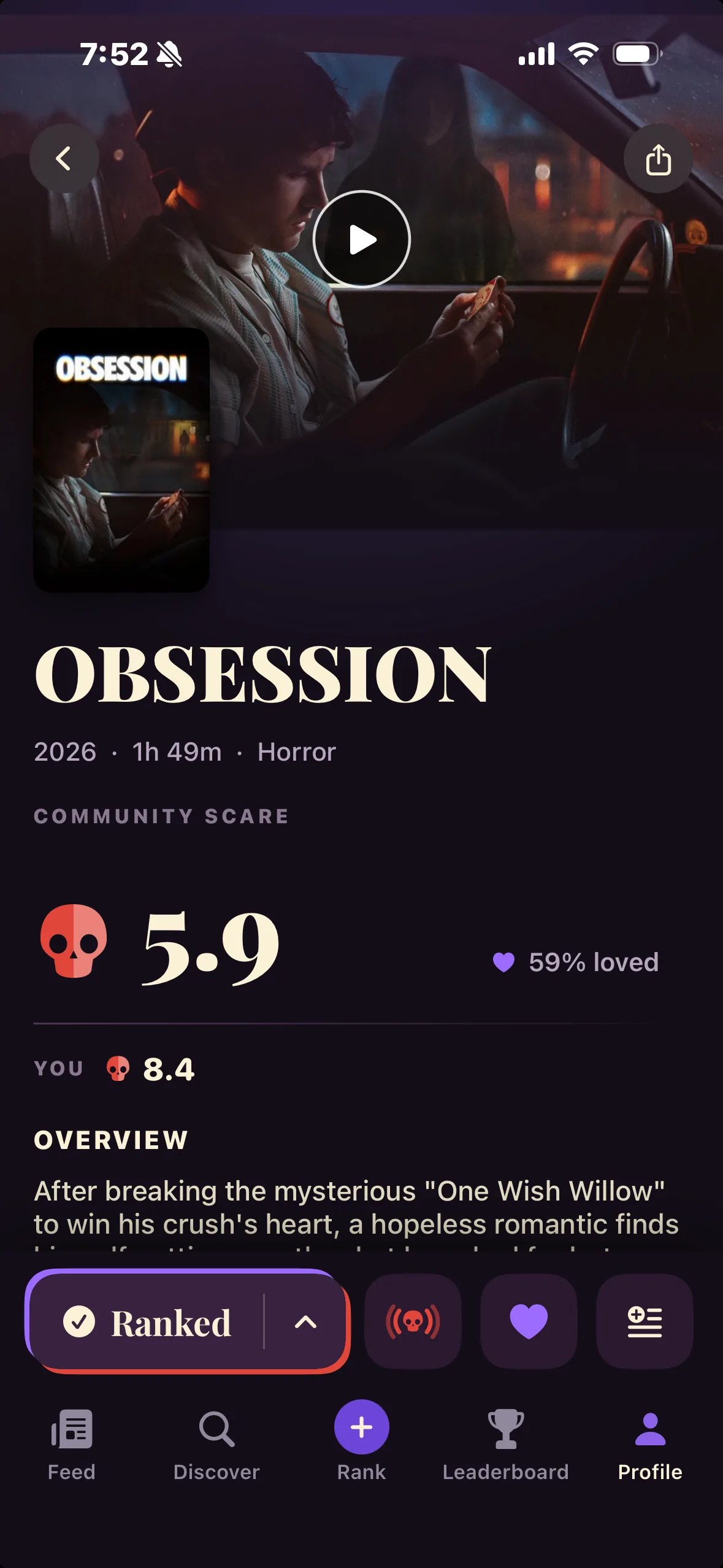
What it looks like.
A film page: the Community Scare, the percentage who loved it, your own number and the Ranked button.
How it works, in three steps.
- 1Members rank the filmEach one places it in their own list through head-to-heads.
- 2Gasper averages their scare scoresEvery personal score feeds the figure as an anonymous part of the whole.
- 3You see it next to your ownThe film page shows the Community Scare, the percentage who loved it, and your score under YOU.
Every film page on Gasper shows two numbers side by side: the Community Scare, the average scare score of everyone who ranked that film, and yours, under "YOU". The gap between them is where the conversation starts.
What it is
The Community Scare is a single number out of 10, drawn from every member who ranked the film. Next to it sits the percentage who loved it, "N% loved", which answers a different question: not how scary, but how loved. A film can have a modest Community Scare and a high loved percentage, which is the signature of a cult favorite. The reverse is the signature of a film that works and is no fun at all.
Only members with at least 5 ranked films count toward it, because a scare score only means something once there is a list to read it from. It is the number the leaderboards use for the Films board, and the number your Scare Tolerance is measured against.
How it is made
Each member's scare score for a film is a readout of where it sits in their personal ranked list. The Community Scare is the average of those readouts across everyone who has ranked it. Your rankings feed it only as part of that anonymous aggregate: no one can see that you specifically gave a film a 9.2, only that the average is what it is.
Because every input is a position in someone's list rather than a star they typed, the average is steadier than a conventional rating. Nobody can give a film ten out of ten on a whim; to score a ten you would have to find it scarier than everything else you have ever ranked, which is a real claim with real head-to-heads behind it.
The figure changes as more people rank the film, and it reflects the people on Gasper, who skew toward the genre's regulars. A Community Scare is a reading of how horror fans felt, not how a general audience would.
Your score next to the crowd's
The point of showing both is the gap. Rank The Witch (2015) and find it an 8.8 against a crowd that averages lower, and you have learned something: slow, period dread gets to you more than it gets to most. Rank a famous shocker low against a high crowd average and you have learned the opposite.
Across your whole list those gaps become your Scare Tolerance. The single widest gap, in either direction, becomes your Hottest Take, which is the one of your fear stats most worth talking about. A film page is where you first see each gap, one film at a time, and it is worth pausing on. A disagreement with the crowd is more informative than an agreement.
Why an average of lists beats a star average
Star averages on other services suffer from two things: everyone's five stars mean something different, and a film's reputation pulls ratings toward itself. A classic collects fives from people who felt obliged to give them, and a divisive film collects ones from people who wanted to make a point.
Head-to-heads resist both. The question "which was scarier" has no reputation in it, only memory, and the resulting position is relative to the ranker's own list. Averaging those positions gives a number that is harder to game and more honest about effect. It is still an average, and averages hide spread, but as a single figure for how scary a film landed for horror fans it is the best one available. The compare page on IMDb goes into the difference at length.
What it does not do
The Community Scare does not tell you how scary a film is for you. That is what your own score and your tolerance are for. If you scare easily, read a Community Scare as a floor, not a ceiling.
It does not include love. The percentage who loved it is counted from hearts and shown as its own figure next to the Community Scare, and it never moves the average.
It does not exist for a film nobody has ranked. That page says "Be the first to rank it".
And Gasper does not publish the figures outside the app, so this site will not tell you the scariest film on Gasper. Open the app and check the Films board. The glossary entry on Community Scare has the one-paragraph version.
Questions people ask us.
Can anyone see my individual scare score in the Community Scare?
No. Your score feeds the average only as an anonymous aggregate. What people see on your profile or in the feed is governed by Stealth mode and your account settings.
Why is the Community Scare different from a star average elsewhere?
Because every input is a position in someone's head-to-head list, not a number they typed. To score a film a ten, a member has to have found it scarier than everything else they ranked.
Does the Community Scare include how much people loved a film?
No. It is built from scare scores only. The percentage who loved it sits next to it as a separate figure, counted from hearts.
What if nobody has ranked a film yet?
The page says "Be the first to rank it". Once you have, your score shows under YOU, and the average fills in as more members rank it.
Works well with these.
All features- RankHead-to-head rankingAnswer which film was scarier a few times and Gasper places it in your rankings. You never type a number.
- FriendsFilms and Fans leaderboardsTwo boards on one switch: Films by average scare and Fans by films watched.
- RankScare scoreA measure out of 10 of how scary a film was for you, read from your own ranked list and shown in skulls.
Learn more
Rank what scared you.
Free on the App Store. Log a film tonight, answer which was scarier, and watch your rankings take shape.